Quick answer
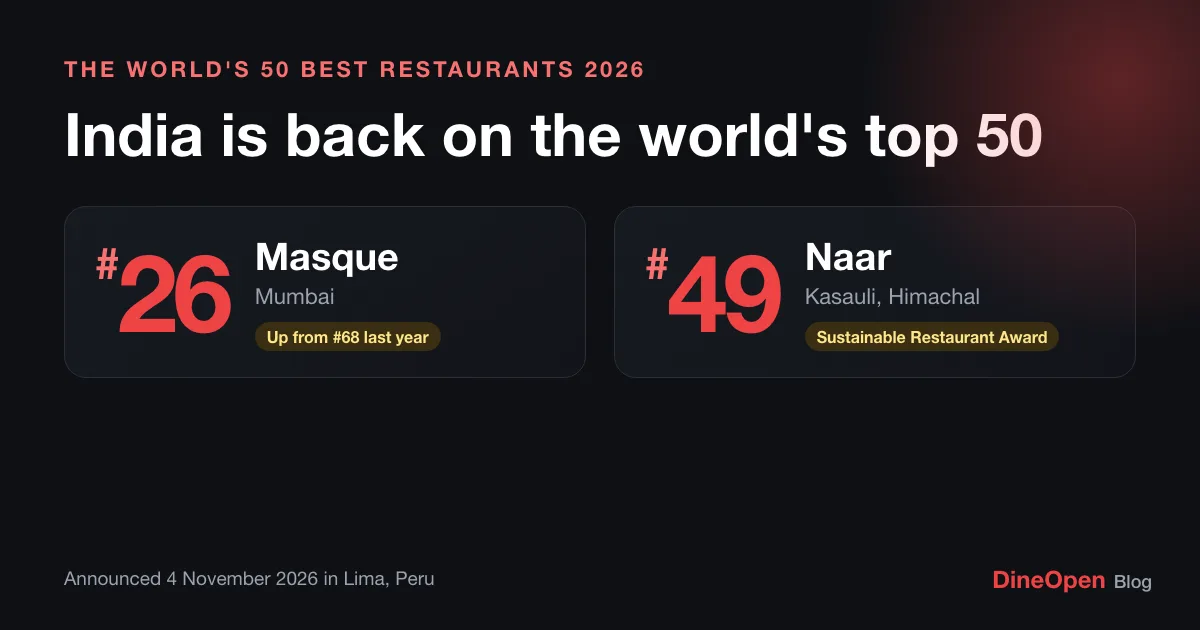
Two restaurants in India made The World's 50 Best Restaurants 2026, announced on 4 November 2026 in Lima, Peru: Masque in Mumbai at No. 26 and Naar in Kasauli, Himachal Pradesh at No. 49. Naar also won the Sustainable Restaurant Award 2026. According to Time Out India, they are the first restaurants based in India in the top 50 since Bukhara in 2004. The No. 1 restaurant in the world for 2026 is Asador Etxebarri in Spain.
Most of us will never run a tasting-menu restaurant, and that's fine. You don't have to book one to learn from the two Indian kitchens on this year's list. What got Masque and Naar there is mostly ordinary work done very well: buying smart, changing the menu with the seasons, wasting less, and making guests feel looked after. Here's what happened, and six things you can try in your own restaurant, café or cloud kitchen this month.
What happened on 4 November
The World's 50 Best Restaurants is a yearly ranking put together from the votes of more than a thousand chefs, food writers and well-travelled diners. It isn't a guide like Michelin. It's a list, and it moves a lot of bookings. The 2026 edition was announced in Lima, and India had a good night.
- Masque, Mumbai: No. 26. Opened in 2016 by Aditi Dugar in an old mill compound in Mahalaxmi, with chef Varun Totlani now running the kitchen. It was No. 68 on last year's extended 51–100 list, a jump of 42 places.
- Naar, Kasauli: No. 49. Chef Prateek Sadhu's 16-seat restaurant in the hills of Himachal. Its name means "fire" in Kashmiri. It is Naar's first time in the global top 50.
- Naar also won the Sustainable Restaurant Award 2026. The organisers pointed to its work with small local producers, its links with the community around it, and its low-impact cooking.
One more name Indian readers will spot: Gaggan in Bangkok, at No. 2. It's run by Kolkata-born chef Gaggan Anand, so it's not an India-based restaurant, but it shows how far Indian flavours travel.
The top 10 for 2026
| Rank | Restaurant | City |
|---|---|---|
| 1 | Asador Etxebarri | Atxondo, Spain |
| 2 | Gaggan | Bangkok, Thailand |
| 3 | Alchemist | Copenhagen, Denmark |
| 4 | Quintonil | Mexico City, Mexico |
| 5 | Wing | Hong Kong |
| 6 | The Chairman | Hong Kong |
| 7 | Kjolle | Lima, Peru |
| 8 | Kadeau | Copenhagen, Denmark |
| 9 | Diverxo | Madrid, Spain |
| 10 | Plénitude | Paris, France |
The full 1–50 list, with every special award, is on the official site: the50.com.
It wasn't overnight
It's easy to read a headline like this and think it came from one lucky year. It didn't. Both restaurants climbed one list at a time.
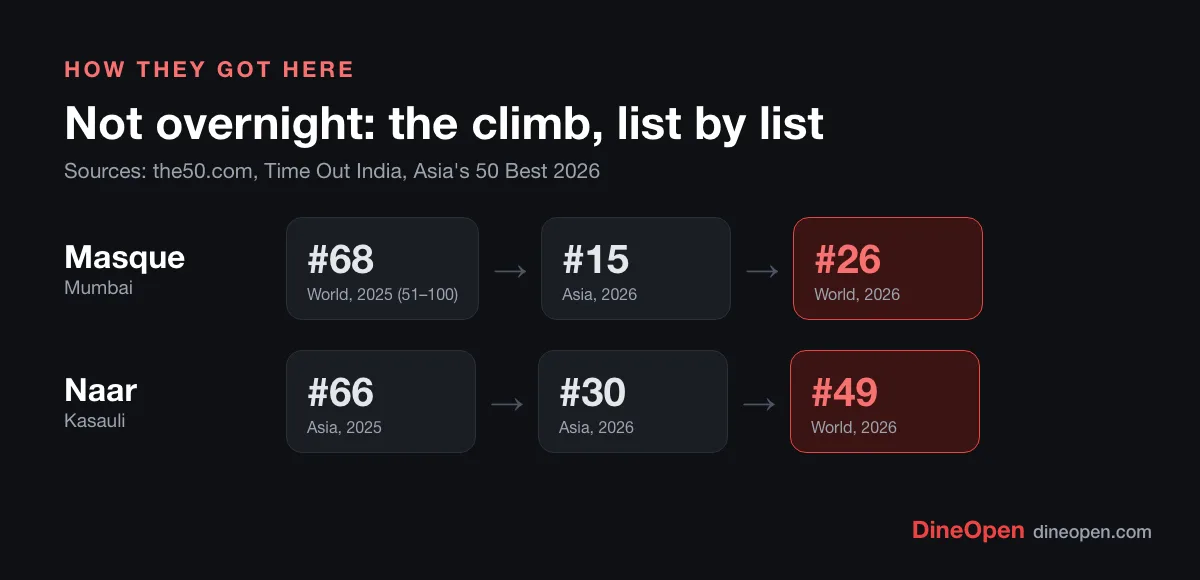
Masque has been open for ten years. Naar has worked its way up the Asia list first. Neither of them got there with one viral dish. They got there by doing the same things a bit better every service, and that is the part any owner can copy.
6 lessons you can use in your own restaurant
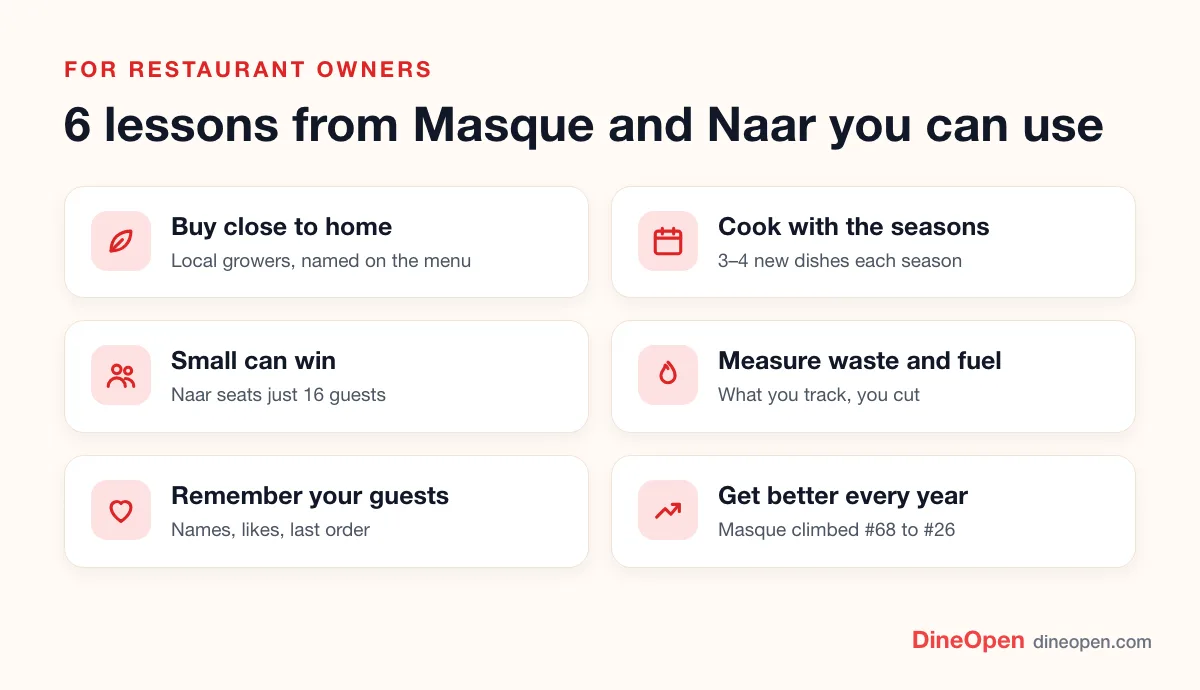
1. Buy close to home, and say so on the menu
Naar gets its ingredients from small local producers, and what they can't supply is grown on site or foraged nearby. Masque buys from all over India and is known for putting Indian produce front and centre.
You don't need a forest. Pick two or three things you buy every week (paneer, greens, eggs, coffee beans, ghee) and find a farm or small dairy within a few hours of you. Then put their name on the menu: "Palak from the Sharma farm, Sonipat". Guests notice, the quality is often better, and when the middleman is gone the price can be better too. Just check the numbers with a recipe cost calculator before you switch.
2. Let the menu follow the seasons
Masque's menu changes with the season, and Naar's follows the seasons of the mountains around it. Seasonal produce costs less when it's at its peak, it tastes better, and it gives regulars a reason to come back.
Keep your core menu the same, and add a small "this season" section of three or four dishes: mango in May, sarson in January, corn and bhutta in the monsoon. After a month, look at your sales report. Keep the dish that sold, drop the one that didn't, and try something new. Our menu engineering guide explains how to read those numbers.
3. Small can win
Naar has 16 seats, and it isn't in a metro. It's in the hills near Kasauli. People drive there because of what it is, not because they were passing by.
If you're tempted to open bigger, think about it the other way round. A smaller room with a tight menu means less stock sitting in the fridge, a smaller team you can train properly, and a place people talk about. Before signing a lease, run the numbers in the food business profit calculator. A full 30-seat room is usually a better business than a half-empty 80-seat one.
4. Measure your waste and your fuel
Part of why Naar won the sustainability award is how it cooks: most of the cooking is done over wood fire rather than gas, and it is built around low-impact cooking. You may not want to give up gas, especially after this year's LPG shortage, but you can start measuring.
For two weeks, write down what you throw away at closing: the item, the amount, and why. Most kitchens find the same two or three culprits, such as an over-prepped gravy, a slow dish, or bread ordered in bulk. Cut those, and track your stock in the POS so it tells you what is running low before you over-order again. There's more on this in how to cut food waste.
5. Remember your guests
Earlier this year Masque won the Art of Hospitality Award at Asia's 50 Best Restaurants. That award is about how guests are treated, not what's on the plate.
Hospitality is mostly memory. Mr. Iyer likes the corner table. Priya is allergic to peanuts. The family from Andheri always orders the dal first. When your team can see a guest's last order and notes the moment they sit down, a regular feels like a regular. You can do this with a notebook, but a POS that saves the customer's phone number, past orders and notes does it for every shift, including the days your best captain is off. A simple loyalty programme helps you say thank you to the people who keep coming back.
6. Get a little better every year
Masque went from No. 68 to No. 26 in one year, after nine years of steady work before that. The lesson isn't "win an award". The lesson is to pick one thing to improve each quarter and keep it up: faster tickets, fewer complaints, better reviews, lower food cost. Write the number down at the start, and check it again three months later.
Try this week
- Call one local farm or dairy and ask for a price on one item you buy every week.
- Add one seasonal special, and give it a month.
- Start a waste sheet at the pass. Two weeks is enough to see the pattern.
- Ask your team to note one thing about every regular: a name, a favourite dish or an allergy.
Run the everyday part with less effort
DineOpen gives you billing, KOT, stock, customer notes and sales reports in one app, on a phone, tablet or computer, so you can spend your time on the food and the guests.
Start your 7-day free trialFrequently asked questions
Two restaurants based in India are on the 2026 list: Masque in Mumbai at No. 26 and Naar in Kasauli, Himachal Pradesh at No. 49. Gaggan in Bangkok, run by Indian chef Gaggan Anand, is at No. 2, but it is based in Thailand.
Asador Etxebarri in Atxondo, in Spain's Basque Country, is No. 1 on The World's 50 Best Restaurants 2026. Gaggan in Bangkok is No. 2 and Alchemist in Copenhagen is No. 3.
The list was announced on 4 November 2026 at a ceremony in Lima, Peru.
Naar won the Sustainable Restaurant Award 2026 from The World's 50 Best Restaurants. The organisers praised its work with small local producers, its community engagement and its low-impact cooking, much of which is done over wood fire rather than gas.
According to Time Out India, the last restaurant based in India in the top 50 before 2026 was Bukhara at ITC Maurya in New Delhi, in 2004. Masque was on the extended 51–100 list in 2025, at No. 68.
Buy a few key ingredients from local producers, add a small seasonal section to your menu, keep the place and the menu tight, track your food waste and fuel use, record what your regular guests like, and pick one number to improve every quarter. None of this needs a fine dining budget.
Sources
- The World's 50 Best Restaurants 2026: the list, 1–50 (the50.com)
- Sustainable Restaurant Award 2026: Naar (the50.com)
- Masque and Naar bring India back to the map (Time Out India, 5 November 2026)
- Asia's 50 Best Restaurants 2026 rankings and Art of Hospitality Award, as reported by Slurrp
DineOpen has no link with The World's 50 Best Restaurants, Masque or Naar. All the images on this page are our own.